You already invested in product, engineering, and growth. But if new users struggle to reach value fast, trial signups stall, adoption drops, and MRR quietly leaks. I audit complex SaaS experiences to expose the exact friction slowing Time-to-Value, feature adoption, and retention.
25+
Years in Enterprise Tech
Founder
To Founder Perspective
TTV
Activation, Adoption, Retention
Observed Trial Drop-Off
68%
Retention Lift After UX Fixes
+34%
MRR ProtectedUsers do not judge your product by your roadmap, your architecture, or your backlog. They judge it by how fast they can understand it, configure it, and reach first value.
Too many steps, too much setup, weak empty states, and unclear next actions delay the first win. That is where paid acquisition starts losing money.
Expensive features often underperform not because they lack value, but because users cannot find them, understand them, or connect them to their workflow quickly enough.
Enterprise buyers do not always complain. They adopt slowly, usage narrows, champions weaken, and renewal risk shows up later in the quarter when it is more expensive to fix.
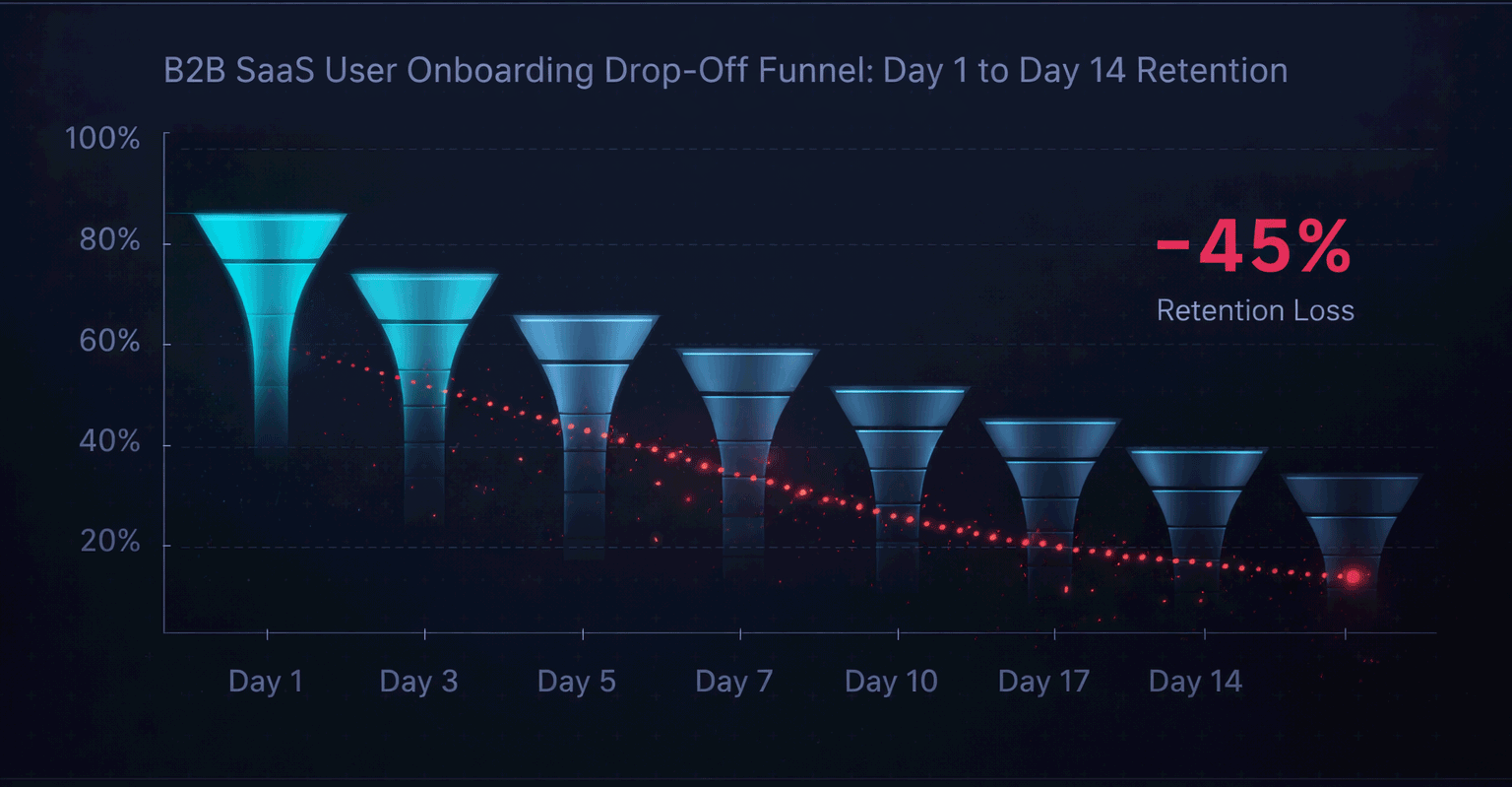
Faster Time-to-Value usually improves activation and reduces early churn risk. The real question is where your current path delays value.
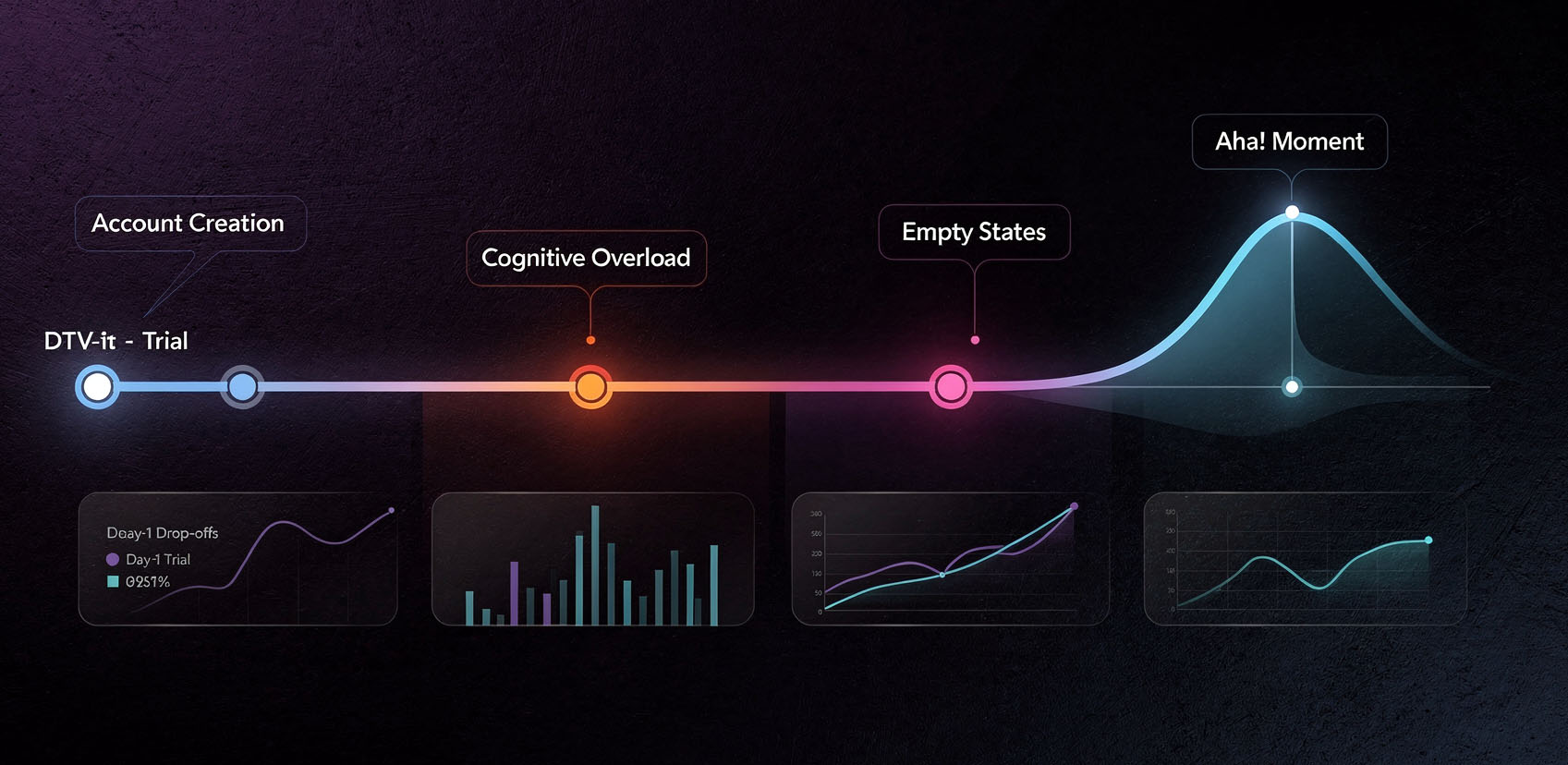
This is not a cosmetic redesign exercise. It is a focused SaaS UX audit built to expose friction in onboarding, navigation, feature discovery, and activation so your team can fix the highest-impact leaks first.
We map the actual path from signup to first meaningful value, step by step, to expose delay, friction, unnecessary inputs, and weak guidance.
We audit core workflows, navigation patterns, and feature discoverability to identify why valuable capability is being missed, delayed, or abandoned.
You receive a decision-ready roadmap showing what to fix first, why it matters, expected business impact, and how your team can implement improvements without unnecessary rebuild work.
Founders usually do not need more features first. They need clearer activation, faster value discovery, and less friction in the first critical sessions.
Apply for a SaaS UX AuditThese examples show the kind of friction we look for: onboarding drag, weak first-run guidance, buried features, and architecture decisions that quietly block growth.
Series-A B2B CRM SaaS
Trial users were dropping before they reached the first useful action. The audit exposed redundant setup inputs, confusing empty states, and weak first-run guidance. We recommended a shorter activation path and a clearer sequence to first value.
Day-14 Retention
+44%
MRR Growth
+18%
Mid-Market Project Operations SaaS
Users were not abandoning because the product lacked capability. They were slowing down because the experience made feature discovery harder than it needed to be. We simplified information architecture and reduced experience overload without removing important functionality.
Churn Rate
Dropped 27%
LTV Expansion
+3.2x
"We assumed the problem was feature depth. The audit showed the real issue was activation friction and weak discoverability. Once that became clear, our roadmap decisions became much easier."
Founder
VC-Funded SaaS Company
This is a focused 30-minute founder-level review to understand whether your biggest product experience issue sits in onboarding, architecture, feature discoverability, or early-stage user flow friction.
Quick diagnosis of activation and onboarding friction.
Early view of where Time-to-Value is slowing down.
Guidance on whether a full audit is the right next move.
Direct. Focused. Founder to founder.
Apply for a SaaS UX AuditBest fit for funded SaaS products with complex onboarding or feature adoption issues
Practical thinking on Time-to-Value, onboarding, information architecture, and the UX decisions that shape product-led growth.
If your free trial is generating sign-ups but not qualified pipeline, you do not have a lead problem. You have...
A bad pricing page does not just hurt conversion. It lowers the quality of every single sales conversation that comes...
If your time to value SaaS onboarding is slow, you are not dealing with a minor UX problem. You are...
Everything you need to know about the SaaS UX Audit process and deliverables.
You receive a prioritized UX action plan focused on activation, onboarding, architecture, and feature discovery. The output is built to help your team understand what to fix first, why it matters, and where the likely business impact sits.
No. The audit is designed to surface the highest-impact UX friction first, which often means targeted fixes in flows, hierarchy, labels, empty states, and navigation before any large rebuild is justified.
That is usually where this work is most useful. Complex SaaS products often lose users through setup friction, role confusion, buried capability, and overloaded interfaces. The audit is built for those realities, not in spite of them.
No. The same audit lens can apply to SaaS web apps, enterprise portals, and mobile product flows. The exact focus changes by platform, but the core question stays the same: where is the experience delaying value or weakening adoption?
Internal teams often know the product too well. That creates blind spots around first-use friction, discoverability issues, and language that makes sense internally but not to users. An outside audit is useful when you need a clearer read on what real users are likely struggling with.
That is normal. The point of the audit is not to hand over abstract opinions. It is to make trade-offs visible, explain the rationale, and help your team decide which changes are worth acting on given product goals, engineering constraints, and business timing.
Yes. If needed, the work can extend into advisory support so your team can implement changes with stronger alignment between product, UX, and engineering rather than guessing through execution.