
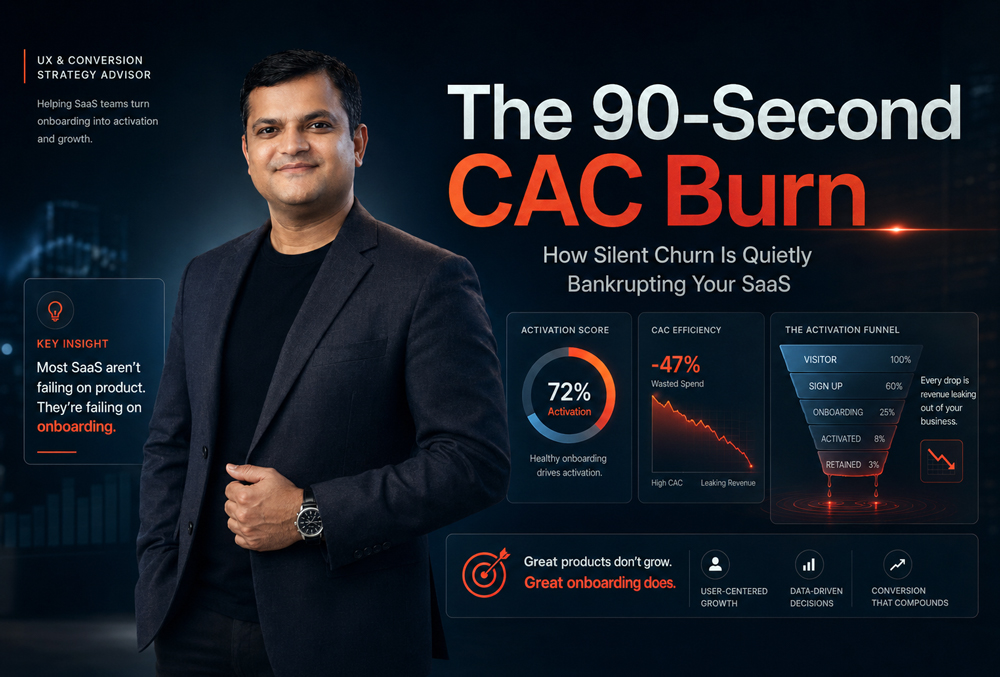
SaaS silent churn happens when a user signs up but abandons your platform within minutes due to high friction and delayed value. To stop bleeding your Customer Acquisition Cost (CAC), SaaS founders must optimize the first 90 seconds of onboarding. Replace feature tours and blank dashboards with a “Minimum Viable Onboarding” script that drives users to a definitive, momentum-building psychological win.
You just paid a premium to acquire a user who will never read your documentation.
That is the real problem behind SaaS onboarding optimization. Not tooltips. Not welcome screens. Not making a prettier dashboard. The reality is that your product gets judged before your sales team ever gets a second conversation.
Modern B2B buyers don’t study manuals; they judge momentum. They expect a self-directed, digitally mediated experience where your product does the selling, educating, and trust-building. If your product architecture doesn’t deliver a definitive psychological ‘win’ within the first 90 seconds of login, users will ‘silently quit’-and your entire Customer Acquisition Cost (CAC) is instantly vaporized.
As the CTO and Co-founder of UXGen Advisory, I don’t care about making things look pretty. I care about business-first analytics, revenue metrics, and conversion paths. Stop bleeding your runway on users who never activate. Here is the ruthless, 90-second UX onboarding script that elite SaaS companies use to stop silent churn.
What Silent Churn Actually Means in SaaS
Silent churn isn’t when a user cancels their paid subscription after six months. That’s vocal churn. You can track that.
Silent churn happens when a user signs up, logs in, fails to experience value, and disappears without giving feedback. No angry email. No cancellation call. No support ticket. Just inactivity.
For funded SaaS founders and CEOs, this is not a design issue in isolation. It is a unit economics crisis. A user who never activates creates a cascade of commercial problems:
- Paid acquisition cost is entirely wasted.
- Demo-to-trial conversion weakens.
- Trial-to-paid conversion drops.
- Customer success inherits confused users.
- Retention problems start before the customer is even “live.”
You shouldn’t treat onboarding as a product walkthrough. It is your first revenue protection layer after acquisition. The question isn’t, “Is our onboarding nice?” The question is, “Are we protecting the money we already spent to acquire this user?”
The 90-Second Rule: Your First Login Is a Revenue Test
The “90-second CAC burn” is a practical UX audit lens. It doesn’t mean your complex enterprise SaaS must deliver its full, finalized value in a minute and a half. That’s unrealistic.
It means the user must feel one of these things immediately:
- “I know where I am.”
- “I understand what to do next.”
- “This product understands my goal.”
- “I can see the path to value.”
That early psychological win is critical. If the first session creates uncertainty, the user starts calculating effort. If the perceived effort is higher than the perceived reward, they mentally exit.
Where SaaS Onboarding Usually Breaks
Most onboarding failures aren’t caused by one bad screen. They come from structural friction. We see the same patterns bankrupting SaaS products over and over:
- The Blank Slate of Death: Dropping a new user into an empty dashboard. User feels: “There is nothing here.” Result: Low activation.
- The Feature Dump (Generic Tours): Forcing users into an unskippable 15-step tooltip tour. User feels: “This does not match my goal.” Result: Weak engagement.
- The Interrogation Form: Too many setup steps before seeing the UI. User feels: “This will take too much time.” Result: Trial abandonment.
- No Clear Success Moment: User feels: “What did I actually achieve?” Result: Poor product-qualified leads.
A founder might look at this data and think, “These users just aren’t serious.” But serious users leave bad onboarding too. B2B users are busy operators trying to solve a business problem. If you don’t reduce their uncertainty fast, they leave.
Activation Is the Metric Founders Should Watch Closely
Activation is not the same as a login. A login just means they entered the building. Activation means the user reached a meaningful value milestone.
For a SaaS CEO, this is the only signal that matters at the top of the funnel: Out of every 100 acquired users, how many reach the first meaningful value event?
- CRM: Weak (User creates account) → Strong (User imports leads and creates first follow-up task).
- Analytics SaaS: Weak (User views dashboard) → Strong (User connects data source and sees first insight).
- HR SaaS: Weak (User completes profile) → Strong (User publishes first job or sends employee invite).
Activation answers one simple question: “Did the user experience enough value to justify returning?”
The Ruthless 90-Second UX Onboarding Script
If you want to drive CAC recovery, use this Minimum Viable Onboarding (MVO) script to audit your first login experience:
- First 10 Seconds: Orientation The user must instantly understand where they are and what the next action is. Avoid empty screens.Better pattern: “Welcome, Vaibhav. Let’s build your first revenue leakage report in 3 steps.” This gives context, outcome, and momentum.
- Next 30 Seconds: Goal Selection Don’t make everyone follow the same path. Ask a simple role or goal question: “What outcome matters most right now?” This personalizes the journey without heavy friction.
- Next 30 Seconds: Guided First Action Don’t explain five features. Drive ONE action. Connect a data source, upload a file, or generate a report. The goal is movement toward value.
- Final 20 Seconds: Visible Progress End the first session with proof. Show the completed progress, the value unlocked, and the next best action. Users remember momentum.
🛑 Gated Lead Magnet: The 90-Second SaaS Onboarding Audit Kit
Find out exactly where your onboarding is leaking activation, wasting CAC, and delaying time-to-value before your next billing cycle.
What you get inside:
- First-login UX audit checklist
- Silent churn diagnosis worksheet
- Founder-level onboarding KPI dashboard
- Time-to-value reduction framework
👉 Download the 90-Second SaaS Onboarding Audit Kit Here
Why UXGen Advisory Is the Best Partner for Solving This
At UXGen Advisory, we are not a UI beautification agency. We specialize in UX Audit & Conversion Intelligence. We work exactly at the intersection where product experience, conversion behavior, revenue leakage, and user decision psychology meet.
For funded SaaS startups, your biggest growth bottleneck usually isn’t traffic or your sales script. It is the hidden friction between acquisition and activation. We diagnose where users lose confidence, where onboarding creates unnecessary cognitive effort, and where your product fails to prove value fast enough.
Case Study: Plugging a B2B SaaS Onboarding Leakage
- The Context: A funded B2B SaaS company had strong demo interest and decent trial signups, but their trial-to-paid conversion was heavily underperforming. They assumed it was a sales follow-up issue.
- Our Diagnosis: We ran a heuristic UX audit and mapped their first-session friction. We found that the first login pushed users into a generic dashboard with no role-based path. Empty states created massive confusion, and the activation event wasn’t even clearly defined.
- The Approach: We stripped it down. We reframed the onboarding around user goals, not features. We defined one primary activation event, redesigned the first-session path around a guided “first win,” and reworked their empty states into action-led prompts.
- The Outcome: Activation rate improved by 34%. Trial-to-paid conversion improved by 18%. Support questions from new users dropped by 22%.
As the client realized: “We thought users needed more education. The audit showed they needed faster proof.”
FAQ: SaaS Onboarding Optimization and Silent Churn
- What is silent churn in SaaS?
Silent churn happens when users sign up or start a trial but never meaningfully activate. They don’t cancel or complain; they just stop logging in. It’s dangerous because it masquerades as low engagement, but the root cause is usually onboarding friction or a delayed “Aha!” moment. - Why does onboarding impact CAC payback?
You only recover your acquisition costs when users convert and retain. If users drop before activation due to poor onboarding, your marketing spend is wasted. Strong onboarding improves activation, lowers support dependency, and accelerates CAC payback. - What is a good activation event for SaaS?
A good activation event is the first meaningful action proving the product’s core value. It’s not a vanity metric like “profile completed.” For an email marketing tool, it’s sending the first test campaign. For a CRM, it’s importing a lead list. - How do you reduce silent churn in SaaS onboarding?
Simplify the first login. Define one clear activation event, remove non-essential setup fields, replace blank dashboards with guided templates, and show visible progress. Don’t rely on long product tours; build contextual, task-based guidance. - Is product onboarding a UX or growth problem?
It is both. It looks like a UX problem because it involves interaction design and screen flows. But commercially, it is a growth problem because it directly dictates your activation rate, trial conversions, and retention efficiency. - What is time-to-value (TTV) in SaaS?
TTV is the amount of time it takes for a new user to experience a meaningful win from your product. A shorter TTV builds customer confidence instantly, while a long TTV creates friction because users have to invest too much effort before seeing proof. - Why do SaaS users ignore documentation?
Because they are trying to solve an immediate business problem, not study for an exam. Documentation is necessary, but it shouldn’t be your onboarding strategy. Contextual, in-product guidance at the exact moment of confusion works far better. - When should a SaaS company run an onboarding UX audit?
You need an audit when your trial-to-paid conversion is below industry benchmarks, product-qualified leads are weak, support tickets from new users are high, or your sales team complains that “leads aren’t serious.”
Conclusion: Stop Buying Users Your Product Cannot Activate
Silent churn is not loud. That is exactly why it is so expensive.
It doesn’t show up as a dramatic failure. It shows up as weak activation, poor trial conversion, longer sales cycles, and rising CAC pressure. The first 90 seconds of your onboarding will not close the full enterprise deal, but it will absolutely decide whether the user gives you a chance to.
For funded SaaS founders, this is the new operating rule: Do not scale acquisition until your first-session experience can create confidence, direction, and undeniable proof of value.
If your SaaS is getting signups but users aren’t activating, stop guessing. Audit the onboarding. Find the friction. Protect your CAC. Build the first win.
Want to know exactly where your SaaS is silently leaking revenue? Download the audit kit from the link above or drop a comment / send a DM with the word AUDIT to request a founder-level onboarding teardown from UXGen Advisory.
